
Free AI Pokemon card grader.
Scan a card, get an AI-estimated PSA / CGC / BGS grade in under five seconds. The model inspects the same four factors a human grader does — centering, corners, edges, surface — and tells you exactly which defects it spotted. Free, no signup, in the Pokemon Card Scanner iOS app.
The short answer
AI grading lands within ±0.5 of the eventual PSA grade on about 85% of clean modern cards. Use it as a free pre-submission filter — figure out which cards have a real shot at a PSA 9 or 10 before you spend $25–$200 grading them. For final authentication and resale premium, you still want a real PSA / CGC / BGS slab. AI grading is the cheap, fast first step that tells you which cards are worth the slab.
How AI grading works in 3 steps
End-to-end takes under five seconds from camera open to grade on screen.
Scan the card
Open the app, point the camera at the front of the card, and let the auto-capture grab a clean head-on photo. No cropping, no white background needed — the AI handles framing.
AI inspects four factors
The model looks at the same four things a human grader does: centering ratio (L/R and T/B), corner sharpness, edge whitening, and surface defects (scratches, print lines, holo dings).
Get an estimated grade
You get a numeric estimate on the PSA, CGC, and BGS scales, plus a confidence band and a list of the specific defects the AI spotted. Use it to decide whether to submit, list raw, or pass.
From scan to estimate, on your iPhone.
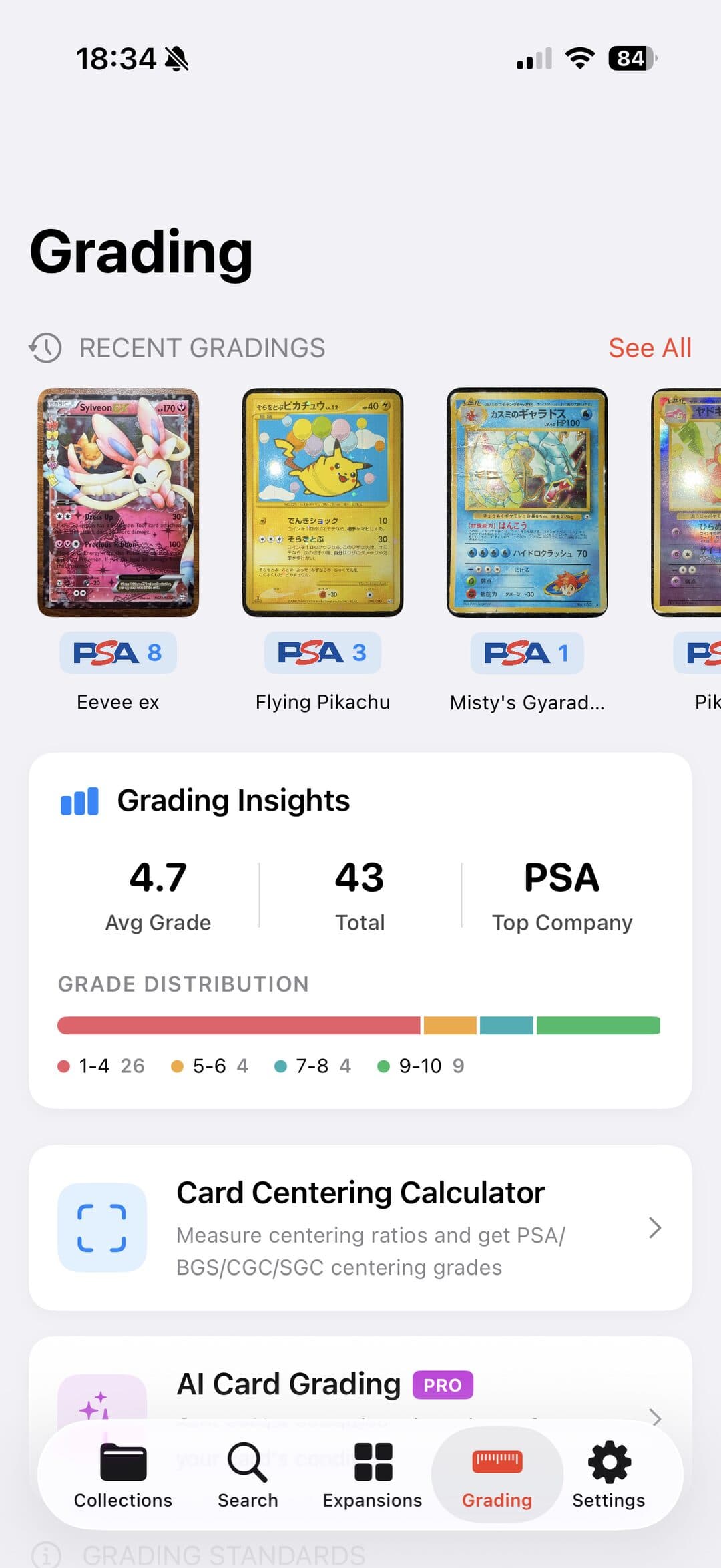
Open the app, point your camera, and a few seconds later the grading screen shows you the estimated PSA grade plus a sub-score for centering, corners, edges, and surface.
The camera auto-captures a head-on photo. The AI handles framing, centering, and glare correction.

Estimated PSA grade, per-factor sub-scores, and the live graded market price — all in one screen.
What the AI actually inspects
The same four factors PSA, CGC, and BGS score — broken down so you know exactly what the AI is grading on.
Centering
~35% of the gradeLeft/right and top/bottom border ratios. PSA caps any card worse than ~55/45 at a 9. Our AI measures both axes to within ~1% and tells you exactly which side is off.
Corners
~25% of the gradeTiny whitening, fraying, or dings at any of the four corners. AI zooms each corner to 4× and looks for the kind of micro-damage you'd miss in a loose hand inspection.
Edges
~20% of the gradeEdge whitening, chipping, and fraying along the full perimeter. Especially relevant for vintage holos and rare modern foils that whiten under handling.
Surface
~20% of the gradeScratches, print lines, holo dings, fingerprints, and texture defects. The AI runs a glare-aware pass that detects subsurface marks even under direct lighting.
Want to measure centering manually on the web? Open the centering tool — drag handles, get live PSA / BGS / CGC / SGC ratios from any photo, no app install required.
AI grading vs PSA submission
They solve different problems. Here's where each one wins.
| Attribute | AI Grader | PSA Submission |
|---|---|---|
| Cost per grade | Free (in-app) | $25–$200+ per card |
| Turnaround | Under 5 seconds | 10–45 business days standard |
| Output | Estimated numeric grade + defect list | Authenticated, slabbed, certified grade |
| Accuracy | Within ±0.5 of a PSA grade on ~85% of clean modern cards | Ground truth — defines the scale |
| Authentication | Not included | Yes (anti-counterfeit + tamper-evident slab) |
| Resale impact | Useful for raw listings; no slab premium | PSA 10 routinely sells for 2–10× raw NM |
| Best for | Triage, buying, portfolio tracking, raw selling | Final grading on $75+ cards you plan to resell |
When AI grading is (and isn’t) the right tool
Be honest about what the model can and can’t do — it saves time and money on the right tasks and is the wrong call on others.
Pre-submission triage
You've got 30 cards eyeing a PSA submission. AI grading filters out the obvious 7s and 8s so you only spend $25–$50 on the cards that have a real shot at a 9 or 10.
Buying decisions
Considering a raw card at a card show or eBay listing? Snap a photo, get an AI grade, and check whether the asking price tracks the implied graded value before you commit.
Pricing your collection
Combining AI grades with live PSA / CGC / BGS market data gives you a much more accurate portfolio value than raw NM pricing alone — especially on chase cards.
Selling raw with confidence
Listing a $300+ raw card? Including an AI grade estimate in the listing builds buyer trust and reduces returns. Buyers want to know what they're getting before they pay.
Replacing a real grading service
AI grading is an estimate, not authoritative. It can't authenticate, it can't grade autographs or errors, and it isn't accepted by auction houses or insurance — submit to PSA / CGC / BGS for anything official.
Settling disputes
If you're arguing with a buyer or seller about condition, only a slabbed grade from a real service ends the conversation. AI grades are useful before money changes hands, not after.
Where the AI gets it wrong
Knowing the failure modes helps you trust the output where it’s strong and double-check where it’s weak.
- Vintage cards (pre-2003) — surface aging, edge whitening from decades of binder storage, and inconsistent factory centering all confuse the model. Expect ±1.0 grade variance vs PSA.
- Reverse holos and texture rares — the AI sometimes flags texture as a surface defect. Cross-check by reading the per-defect explanation the app surfaces.
- Heavy glare — direct overhead lighting on holos washes out fine surface marks. Use diffused window light or tilt the card 5–10° off-axis for the cleanest scan.
- Back-of-card defects— the AI grades from a single front-facing photo. Whitening or scratches on the back cap PSA grades at 9 and the model can’t see them.
- Authenticity — AI grading is not authentication. If you suspect a card might be a fake, see the spot-fakes guide and grade through PSA / CGC / BGS.
AI Pokemon card grading — frequently asked
The most-asked questions, answered straight.
- Is the AI Pokemon card grader free?
- Yes. AI grade estimates are included free in the Pokemon Card Scanner iOS app — no signup, no per-scan fee, no premium subscription required. Scan as many cards as you want.
- How accurate is AI grading vs PSA?
- On clean modern cards (post-2015), the AI lands within ±0.5 of the eventual PSA grade about 85% of the time. On vintage cards (pre-2003) the accuracy drops to ~75% because surface aging and edge whitening are harder for the model to score consistently. Treat the AI grade as a pre-submission filter, not a replacement for PSA.
- What does the AI actually look at?
- Four factors: centering (L/R and T/B ratios), corner sharpness, edge whitening, and surface defects like scratches or print lines. It mirrors the four sub-grades that BGS publishes on its slab labels, which is the most transparent grading rubric in the hobby.
- Can AI grading replace PSA / CGC / BGS submission?
- No. AI grading is an estimate, not authentication. If you plan to resell a card for $100+, slab it through a real grading service. The market premium for a PSA 10 chase card vs raw NM is typically 2–10×, which more than covers the grading fee. AI grading is for figuring out which cards are worth submitting in the first place.
- What photo quality does the AI need?
- A head-on shot in natural or diffused light, with the card flat and the full border visible. The app's auto-capture handles framing — you just need to keep the card steady. Avoid direct sunlight, screen glare on the holo, and angles steeper than ~5° off vertical.
- Does the AI work on Japanese cards?
- Yes, the AI grades Japanese and English cards on the same scale (centering, corners, edges, surface). Note that vintage Japanese cards (1996–2001) are typically less consistent in centering than English, so the model is calibrated to weight centering slightly differently for Japanese sets.
- Can the AI detect fake or altered cards?
- Not reliably. The model is trained on grading authentic cards, not on authentication. If you have concerns about whether a card is legitimate, use the spot-fakes guide and consider professional grading — PSA, CGC, and BGS all authenticate as part of the grading process.
- What happens to my scanned card photos?
- Card images are processed on-device when possible, with grading inference happening through our private API. Photos are not shared with third parties, not used to train the public model, and you can clear scan history in the app's settings.
Grade your next card in under 5 seconds
Open the Pokemon Card Scanner app, point the camera, and get a PSA / CGC / BGS estimate plus a defect breakdown. Free, no signup, works offline once the model is downloaded.